If you have ever crossed onto Sullivan’s Island and felt the pace shift almost immediately, you are not imagining it. The island stands out not because it tries to do more, but because it has stayed intentional about doing less. If you are exploring Charleston-area communities and want to understand why this one feels so memorable, here is what shapes that experience day to day. Let’s dive in.
Small scale shapes everything
Sullivan’s Island is a 3.5-mile barrier island near Charleston Harbor, and that limited scale is part of its identity. The town has held onto a small-town feel and a relaxed lifestyle, which comes through in both the built environment and the way daily life unfolds.
That sense of restraint is not accidental. The town’s planning approach emphasizes residential character, open space, and careful review of development, commercial construction, subdivisions, and zoning. As a result, Sullivan’s Island tends to feel measured and cohesive rather than overbuilt.
Preservation gives the island continuity
One of the clearest reasons the island feels distinct is its preservation-minded framework. Sullivan’s Island has four National Register districts and three local historic districts, and the Design Review Board reviews new construction and renovations in both residential and commercial districts.
That review process helps protect the island’s visual rhythm. Instead of a streetscape that changes abruptly from block to block, you see an environment that feels edited, connected, and rooted in place.
Design standards support compatibility
The town’s design guidelines do not require one fixed architectural style. Instead, they focus on compatibility in massing, size, scale, materials, and overall design for new construction and additions.
That matters because it allows change without losing character. Older homes, renovated properties, and newer infill can coexist while still fitting the island’s human scale.
Porch-forward homes define the streetscape
Housing style plays a big role in how Sullivan’s Island feels from the street. According to the town’s historic resources survey, the Island Cottage, often called a beach cottage, is the most common historic house type on the island.
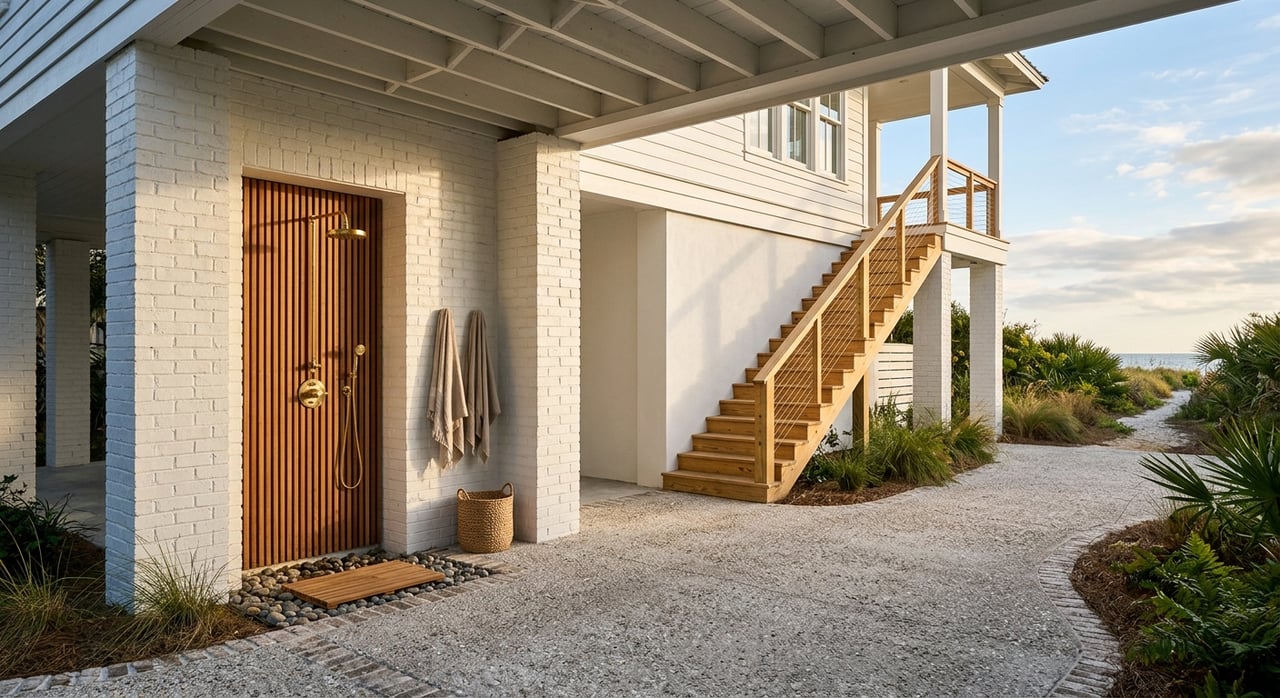
These homes are typically rectangular, low-rise, and porch-forward, often with full-length porches and sometimes wraparound forms. The survey also documents bungalow and laterally gabled house types that tend to be simple in massing and low-slung in profile.
Why the homes feel approachable
When you move through the island, the homes often feel connected to the outdoors rather than sealed off from it. Porches, lower profiles, and modest massing create a more relaxed visual pattern along the street.
That architectural language supports the island’s overall tone. Even where homes vary, the scale tends to feel personal and livable rather than imposing.
Middle Street anchors daily life
Every distinct community has a center of gravity, and on Sullivan’s Island, that is Middle Street. The town’s planning documents identify the business district along Middle Street between Station 22½ and the intersection of Station 20½ and Middle Street.
Within that area, you find restaurants, shops, offices, Town Hall, the fire station, and Stith Park. Instead of a long commercial strip, the island has a compact core that supports daily routines without overpowering the residential setting.
A dining scene with a neighborhood scale
Sullivan’s Island has recognizable dining spots, but the mix stays compact. Places like Poe’s Tavern, Home Team BBQ, Dunleavy’s Pub, and The Longboard give the island a restaurant identity centered on Middle Street.
What stands out is the scale. The dining scene feels like part of the neighborhood fabric, not a separate entertainment district built to dominate the island’s identity.
The beach is public and well managed
The beach is a major part of life on Sullivan’s Island, but its character comes from both access and structure. The town says the island has 3.5 miles of Atlantic beachfront, numerous public beach access paths, and wooden boardwalks and footpaths.
There is also handicap access at Station 26, Station 21, and Station 18½, along with beach wheelchairs available by reservation. Public parking is allowed in the right of way, which helps maintain the island’s public-beach character while keeping access organized.
Rules preserve the atmosphere
Part of what keeps the shoreline experience low-key is the town’s beach regulations. Sullivan’s Island prohibits commercial activity on the beach, motorized vehicles on beach paths and beaches, and alcohol on streets, boardwalks, and beaches.
Those rules help explain why the beach often feels open and accessible without feeling chaotic. The shoreline is public, but it is also carefully managed to protect the island’s everyday rhythm.
Nature and history are part of daily life
Sullivan’s Island is not defined by the beach alone. The town’s 2-mile nature trail links the beach at Station 16 to Fort Moultrie and the Charleston Light, adding another layer to how people experience the island.
The town also highlights places like Battery Gadsden and Fort Moultrie as part of its community connections. That means everyday life here is shaped by heritage landscapes as much as by sand and surf.
A setting with more than one identity
In many coastal communities, the beach becomes the whole story. On Sullivan’s Island, the experience feels broader than that.
You have the shoreline, but you also have preserved streetscapes, historic sites, public paths, and a village-scale center. Together, those pieces make the island feel layered and unusually grounded.
How Sullivan’s Island differs nearby
If you are comparing communities around Charleston, it helps to look at daily rhythm and land use, not just proximity to the water. Sullivan’s Island stands apart because its identity feels strongly residential and preservation-first.
Official materials for Isle of Palms place more emphasis on beach services, visitor resources, accessibility information, parking, and visitor-facing amenities. Mount Pleasant, by contrast, presents as a much larger place with shopping centers, farmers markets, and hundreds of restaurants, with Old Village as one small-town pocket within the broader town.
Why the contrast matters
Sullivan’s Island feels more like a single, tightly held village. It has one compact business spine, a strong residential focus, and a level of design review that helps preserve continuity over time.
That is often what people are noticing when they say the island feels different. The distinction is less about one landmark or one restaurant and more about the cumulative effect of scale, restraint, preservation, and daily ease.
What buyers often notice first
If you are considering a home on Sullivan’s Island, the first impression is often not about any one property. It is the atmosphere created by porch lines, shorter distances, beach access, and the absence of a sprawling commercial footprint.
For many buyers, that atmosphere is the draw. It offers a coastal setting with a clear sense of place, where the public realm, residential streets, and community core still feel closely connected.
Why the island leaves a lasting impression
Sullivan’s Island feels distinct because it has protected the qualities that make it feel like itself. Its small scale, preservation-minded planning, porch-forward housing, compact Middle Street core, managed public beach access, and connection to history all work together.
If you are thinking about buying or selling in one of Charleston’s coastal communities, that kind of nuance matters. The right fit often comes down to how a place feels once you are actually living in it, and Sullivan’s Island offers a rhythm that is hard to replicate elsewhere.
If you want help understanding how Sullivan’s Island compares with other Charleston-area communities, Marisa Cromey would be glad to help you think through the details with clarity and care.
FAQs
What makes Sullivan’s Island different from other Charleston beach communities?
- Sullivan’s Island stands out for its small scale, preservation-minded planning, compact business district, and strongly residential feel.
What is the main commercial area on Sullivan’s Island?
- The town’s planning documents identify the business district along Middle Street between Station 22½ and the intersection of Station 20½ and Middle Street.
What housing styles are common on Sullivan’s Island?
- The town’s historic resources survey says the Island Cottage or beach cottage is the most common historic house type, with bungalow and laterally gabled homes also present.
What is beach access like on Sullivan’s Island?
- The town says the island has numerous public beach access paths, wooden boardwalks and footpaths, accessible entries at Station 26, Station 21, and Station 18½, and beach wheelchairs available by reservation.
What beach rules help shape Sullivan’s Island’s atmosphere?
- The town prohibits commercial activity on the beach, motorized vehicles on beach paths and beaches, and alcohol on streets, boardwalks, and beaches.
Does Sullivan’s Island have places to walk beyond the beach?
- Yes. The town says its 2-mile nature trail connects the beach at Station 16 to Fort Moultrie and the Charleston Light.